China is home to roughly 80% of the world’s LED display manufacturing capacity. For international B2B buyers — system integrators, advertising operators, rental companies, brand owners, and OEM partners — that concentration is good news: more options, faster lead times, and competitive pricing. The challenge isn’t finding a Chinese LED supplier. The challenge is finding the right one for your specific project.
This guide is designed to help. Rather than ranking manufacturers from “best” to “worst” — which rarely makes sense given how different B2B projects can be — we’ve organized 12 well-regarded Chinese LED video wall manufacturers alphabetically, with honest notes on what each one does best, current 2026 price ranges, and the type of project they tend to fit.
What this guide covers
- 12 reputable Chinese LED manufacturers, listed A–Z with specialty notes
- How to match a manufacturer to your application (rental, fixed install, outdoor DOOH, OEM)
- 2026 LED video wall price benchmarks by pixel pitch
- Key technical decisions: SMD vs COB vs GOB packaging
- A practical sourcing workflow for international B2B procurement
Before You Choose a Top 12 Giant: The “Tier 1” Reality Check
Working with a top-tier industry giant comes with peace of mind, but it also comes with a significant brand premium. For mega-projects (e.g., stadium builds or national broadcast centers), Tier 1 brands are the safe choice. However, for mid-sized AV integrators and rental companies, working with the biggest factories often means facing high Minimum Order Quantities (MOQs), longer lead times for small batches, and paying a 20%–40% markup just for the logo on the cabinet. If your project prioritizes fast ROI, deep customization, and direct communication with engineers, a mid-sized “agile” manufacturer might be your smartest alternative.
How to Choose a China LED Manufacturer for Your Project Type
Different projects need different things from a supplier. Before looking at the manufacturer list, it helps to identify which buyer profile fits your project. Most international LED video wall purchases fall into one of four categories:
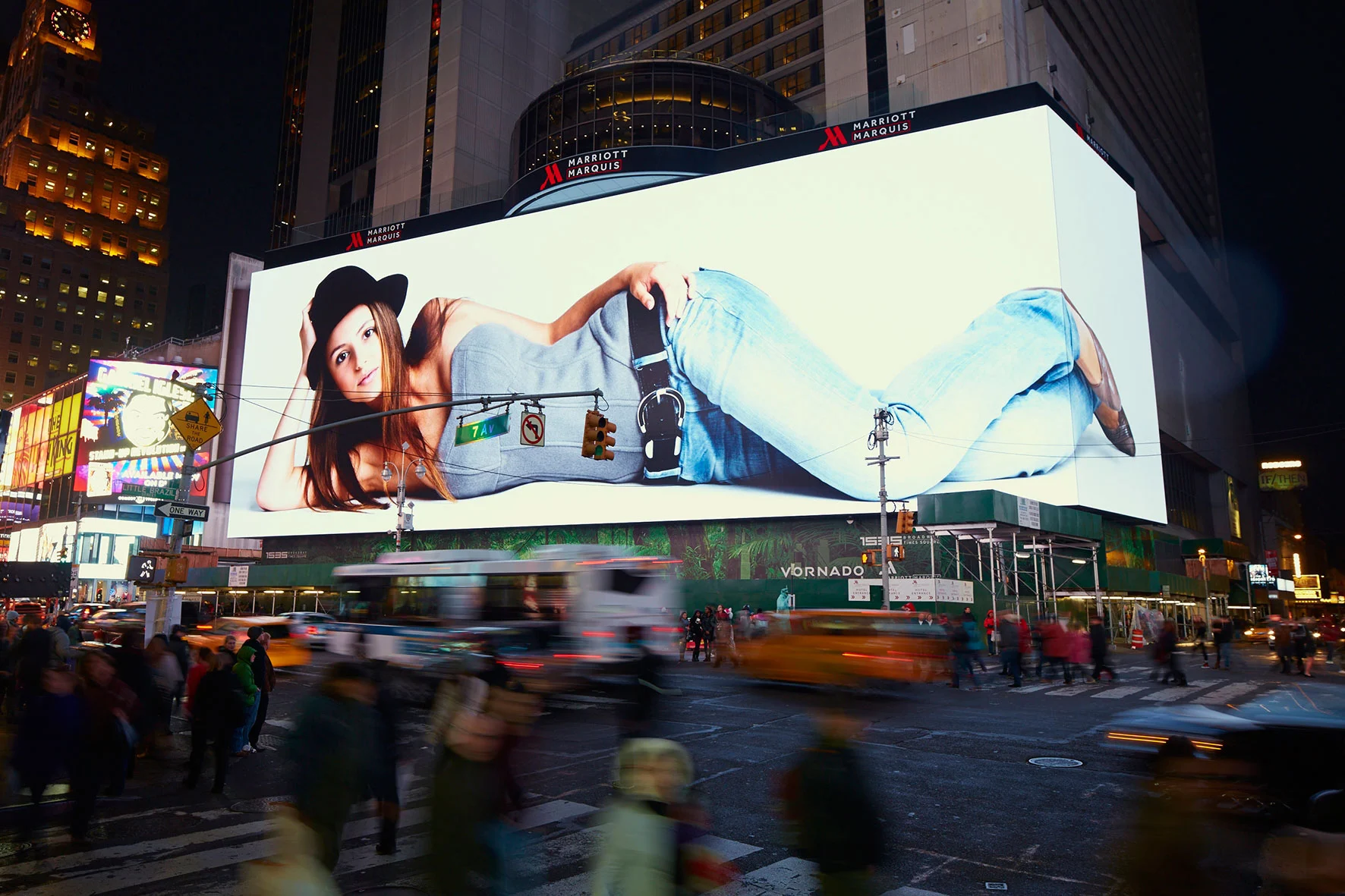
Typical engagement: long-term, custom specifications
Most of the manufacturers in this guide serve multiple categories — but each one tends to excel in one or two. We’ll note that for each entry.
Don’t Make a $50k Sourcing Mistake.
Download our 14-Point LED Procurement Checklist used by pro AV integrators to vet Chinese factories.
What to Look for in a Chinese LED Manufacturer
Once you’ve identified your project type, here are the practical criteria that matter most when shortlisting suppliers. These apply to any factory you evaluate, including the ones below.
1. Production Capacity and Lead Time Reliability

For B2B projects, on-time delivery is often as important as price. The metrics that signal reliable production capacity:
- Factory floor area — 8,000+ m² is healthy for mid-size; 30,000+ m² indicates large-scale capacity
- Number of SMT (Surface Mount Technology) lines — 15+ machines suggest serious production capability
- Monthly output capacity — most established factories will quote this transparently in m²/month
- Vertical integration — True vertical integration in 2026 focuses on in-house PCB layout design, private tooling for die-cast cabinets, and strategic sourcing agreements with top-tier LED lamp suppliers (like Nationstar). This ensures better batch consistency and quality control than factories that simply assemble generic off-the-shelf components.
2. Quality Control and Aging Test Standards
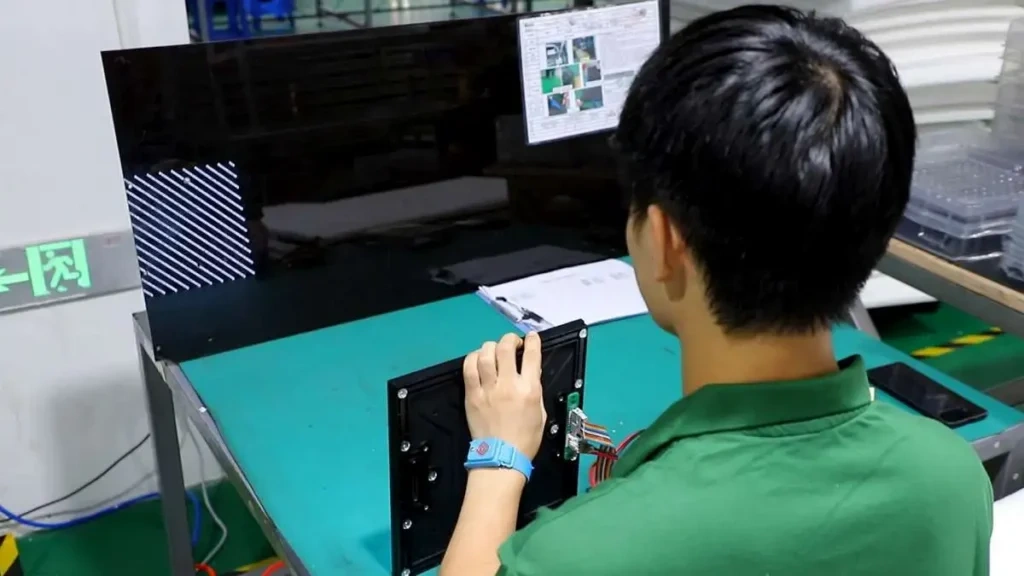
The first 100 hours of LED operation is when most manufacturing defects appear. Industry-standard quality control includes:
- Module-level lighting test after SMT assembly
- 12–24 hour module aging before cabinet assembly
- 72-hour full-screen aging with the entire wall powered on and running content before shipment
- Live Video FAT (Factory Acceptance Test) — Reputable factories now offer remote video inspections and provide a comprehensive Calibration Data Report for the entire screen before it leaves the floor.
3. International Certifications
For shipping to the EU, US, Middle East, or Southeast Asia, your supplier should hold the certifications relevant to your target market:
UL / ETL — The “gold standard” for North America; essential for entering commercial buildings and meeting strict insurance/fire codes. (Note: Our U-slim series maintains full UL certification via Chipshow).
CE & EMC Class B — Required for the EU. While Class A is common, high-end European projects now often demand EMC Class B (for residential/commercial interference protection) and ErP (Energy-related Products) directive compliance for energy efficiency.
- FCC — required for the United States
- RoHS — restriction of hazardous substances, expected globally
- ISO 9001 — quality management system, standard for any export-oriented factory
4. After-Sales Support in Your Region
For multi-year installations, after-sales matters more than the upfront price. Useful questions to ask:
- Do you maintain local warehousing and spare parts centers in my region (US/EU)? Having a 48-hour backup part capability in-country is a game-changer for B2B projects. (A core strength of the Chipshow/Unishine network).
- What’s the typical RMA response time?
- Is remote video diagnostic support available?
- Do you provide technical training for our local installation team?
5. Communication Quality and Technical Engagement
This one is harder to measure but matters enormously over a multi-year relationship. During pre-sales conversations, observe:
- How quickly does the technical team respond to specification questions?
- Can they explain trade-offs (e.g., why one chip brand costs more)?
- Do they push back constructively when your spec seems mismatched to your application?
- Are they willing to recommend a smaller configuration if it serves you better?
A factory that helps you spec correctly — even if it means a smaller order — is usually a better long-term partner than one that simply confirms whatever you ask for.
The 12 Manufacturers (A–Z)
Listed alphabetically, with notes on each company’s strongest capabilities, typical project fit, and 2026 indicative pricing for comparable specifications. All prices are FOB Shenzhen for typical configurations (3840 Hz refresh rate, die-cast aluminum cabinet, standard brightness). Custom specifications, premium chips, and ultra-fine pitch will adjust pricing accordingly.
Absen
Est. 2001 (Shenzhen)Strengths: One of the most internationally recognized Chinese LED brands. Strong global service network with subsidiaries across Europe, North America, and the Middle East. Premium outdoor billboards and rental displays with extensive deployment in landmark venues.
Best fit for: System integrators and brand-conscious end clients; large-scale outdoor advertising; international rental tour operators.
AOTO Electronics
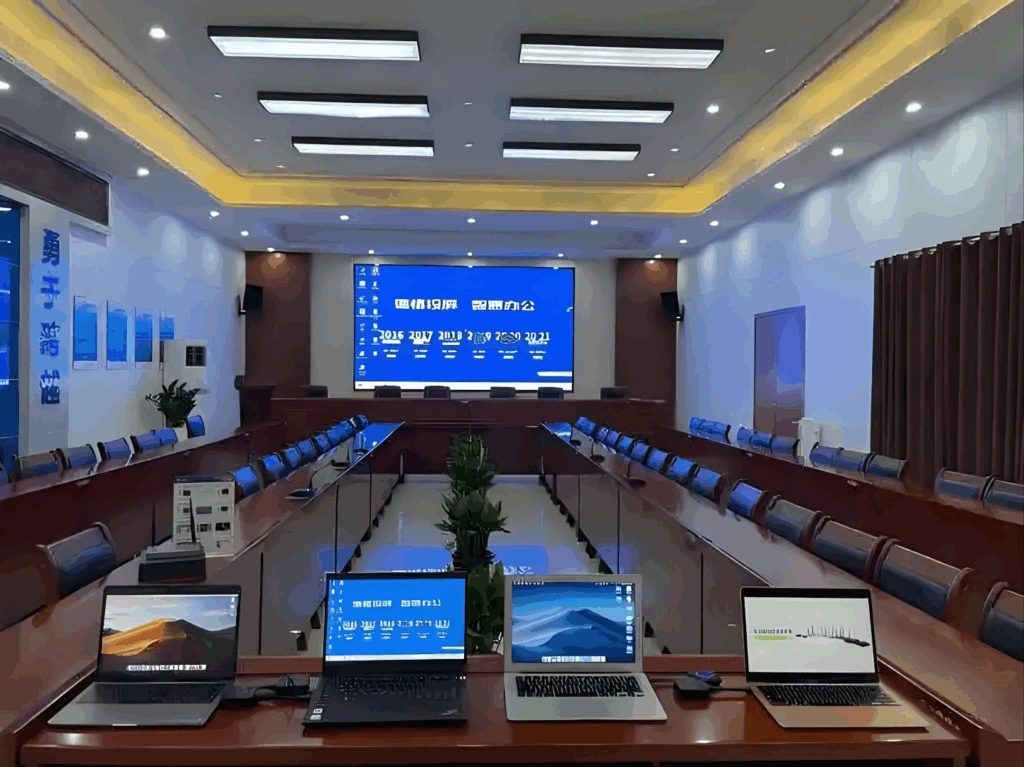
Est. 1993 (Shenzhen)Strengths: Long-established manufacturer with a strong portfolio in conference room displays, virtual production (VP), broadcast applications, and smart pole displays. Significant R&D in fine-pitch indoor technology.
INFiLED
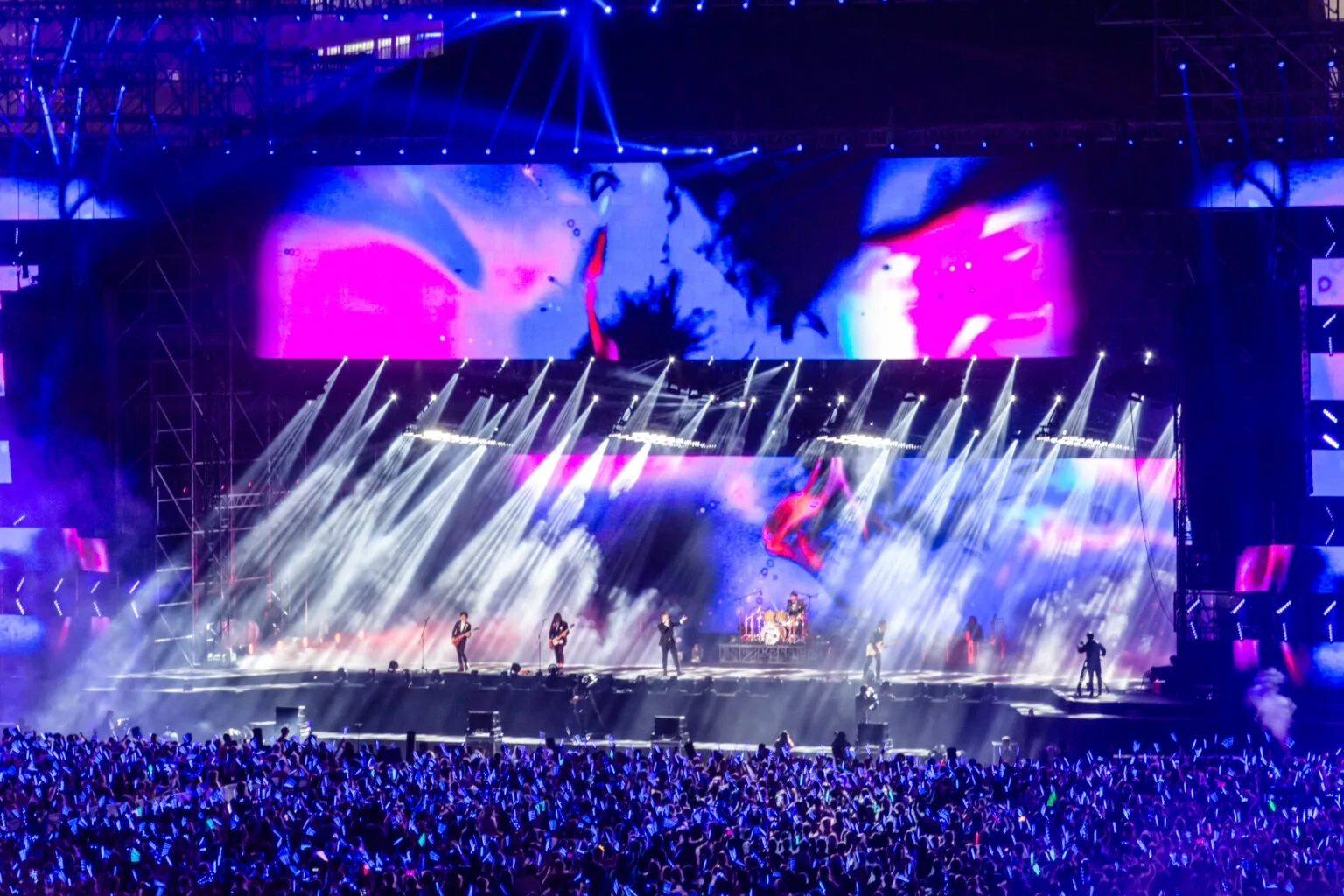
Est. 2007 (Shenzhen)Strengths: Specialist in rental and staging for live events. Lightweight cabinet design and fast deployment systems designed for repeated transport and assembly.
Ledman (Est. 2004)
Strengths: Leader in COB and MicroLED technology. Focuses on premium indoor control rooms and corporate headquarters where image uniformity is critical.
Leyard / Planar (Est. 1995)
Strengths: Global leader in fine-pitch and command center displays. High-stakes government and defense installations. Excellent long-term consistency.
LianTronics (Est. 2003)
Strengths: R&D focused, competitive mid-to-high end indoor displays and COB tech. Good balance of price and build quality.
NovaStar (Est. 2008)
Notes: Not a panel maker, but the industry-standard controller provider. A factory’s choice to use NovaStar is a key quality indicator for B2B buyers.
ROE Visual (Est. 2008)
Strengths: The benchmark for Virtual Production (VP) and film studios. Premium touring entertainment brand with strong EU/US presence.
Sansi (Est. 1993)
Strengths: Specialist in massive outdoor DOOH, smart city pole displays, and transportation hubs. Reliable municipal project history.
Unilumin (Est. 2004)
Strengths: Massive portfolio covering stadium displays, XR volumes, and UMini series. Strong stadium deployment history globally.
Unishine LED
Est. 2019 (Shenzhen)Operating as the agile B2B specialist within the Chipshow group, Unishine focuses on manufacturer-direct partnerships. They deliver Tier-1 specifications (Nationstar LEDs, high-refresh ICs) without the corporate brand premium, making them a top choice for projects requiring fast ROI and direct technical engagement.
Yaham (Est. 2002)
Strengths: Long-established in large-format custom outdoor projects and stadium displays. Strong custom engineering support for architectural LED.
Comparing Quotes from Multiple Factories?
If Unishine fits your project profile based on the description above, we’d be glad to provide a detailed quote alongside whichever other factories you’re evaluating. We provide itemized line-by-line quotes covering panel, controller, spare parts, packaging, and FOB terms — useful for apples-to-apples comparisons.
2026 LED Video Wall Pricing: Market Reference
Pricing varies considerably across the Chinese market depending on configuration and supplier tier. The ranges below are indicative FOB Shenzhen prices for typical mid-market specifications — useful as a benchmark when evaluating quotes. Premium brand suppliers and ultra-premium configurations may price 30%–60% above these ranges; budget configurations may price below.
Indoor LED Video Wall Pricing (per m², FOB Shenzhen)
| Pixel Pitch | Common Applications | 2026 Price Range (FOB) |
|---|---|---|
| P0.9 (Micro LED) | Premium control rooms, executive boardrooms | $4,000 – $8,000 / m² |
| P1.2 (COB) | High-end control rooms, broadcast studios | $2,500 – $4,000 / m² |
| P1.5 – P1.8 | Corporate lobbies, broadcast, premium retail | $1,800 – $2,800 / m² |
| P2.5 | Conference rooms, retail flagships, command centers | $1,000 – $1,600 / m² |
| P3.91 (Rental) | Stages, events, exhibitions, weddings | $700 – $1,100 / m² |
| P4.81 (Rental) | Outdoor festivals, large-scale events | $550 – $850 / m² |
Outdoor LED Video Wall Pricing (per m², FOB Shenzhen)
| Pixel Pitch | Typical Outdoor Applications | 2026 Price Benchmark (FOB) |
|---|---|---|
| P3 Outdoor | Retail facades, premium DOOH, close-viewing outdoor | $1,200 – $1,800 / m² |
| P4 Outdoor | High-quality outdoor advertising, urban DOOH | $900 – $1,400 / m² |
| P5 Outdoor | Standard outdoor advertising, retail signage | $700 – $1,100 / m² |
| P6 Outdoor | Highway billboards, large outdoor signage | $550 – $900 / m² |
| P8 Outdoor | Stadium screens, very large format | $450 – $750 / m² |
| P10 Outdoor | Long-distance highway billboards | $400 – $650 / m² |
Need a Precise Line-Item Quote?
FOB Shenzhen is just the start. Let our engineers calculate your total landed cost including freight and duties.
What Drives Price Variation Within the Same Pitch
Two suppliers quoting “P3.91 outdoor” can legitimately differ by 30%–50%. The main drivers:
- LED chip selection — Premium brands like Nationstar and Kinglight typically command higher prices but offer longer lifespan and more consistent color performance over time
- Driver IC — MBI is widely considered the industry-standard driver IC; alternative ICs may affect refresh rate uniformity and color depth
- Refresh rate — 1920 Hz is acceptable for static signage; 3840 Hz is recommended whenever cameras may capture the screen (events, broadcast); 7680 Hz commands premium pricing for top-tier broadcast applications
- Brightness — A 5,000-nit outdoor panel typically costs ~40% more than a 3,000-nit panel of the same pitch. Specifying brightness appropriate to your environment (rather than maximum) helps optimize cost
- Cabinet material — Die-cast aluminum costs more upfront than steel but reduces shipping weight and rigging complexity, often resulting in lower total project cost
- Power supply quality — Premium power supplies (Meanwell, for example) add modest cost but materially affect mean time between failures
Total Project Cost Beyond FOB
When comparing FOB Shenzhen prices to delivered-and-installed quotes from local distributors, the FOB price typically represents 50%–70% of total landed cost. Items to budget separately:
- Sea freight (China to US/EU): $40–$80 per m² depending on volume
- Customs duty + VAT/GST: 10%–25% of declared value depending on destination country
- Installation rigging and labor: 15%–30% of hardware cost
- Video processor and receiving cards: $1,500–$5,000 (often quoted separately)
- Spare modules: 3%–5% of total panel quantity recommended
Comparison tip
When comparing supplier quotes, request itemized line-by-line breakdowns rather than turnkey “$X per m²” pricing. This makes apples-to-apples comparison far easier and reveals where suppliers may be cutting cost.
Sourcing Workflow: From Inquiry to Delivery
For international B2B buyers new to sourcing LED displays from China, here’s a typical end-to-end workflow that experienced procurement teams follow.
Step 1: Define Specifications Clearly
The single biggest source of quoting delays is incomplete specifications. Before requesting quotes, define:
- Application: indoor fixed install, outdoor fixed install, rental, OEM
- Pixel pitch: based on viewing distance (rule of thumb: minimum viewing distance in meters ≈ pixel pitch in mm)
- Screen dimensions: width × height in meters, with cabinet size flexibility if applicable
- Refresh rate: 1920 Hz / 3840 Hz / 7680 Hz (anything camera-related needs at least 3840 Hz)
- Brightness: indoor typically 800–1,500 nits; outdoor typically 5,000–8,000 nits
- Mounting requirements: wall-mount, hung, floor-standing, curved, special angles
- Target market: US/EU/Middle East/ASEAN — affects required certifications
Step 2: Request Quotes from 3–5 Suppliers
For most B2B projects, getting itemized quotes from 3–5 manufacturers gives a useful price spread without overwhelming your evaluation process. Ask each supplier for:
- Itemized pricing (panel + controller + spare parts + packaging + FOB)
- Lead time for production and shipping
- Payment terms (typical: 30%–50% deposit, balance before shipment)
- Warranty terms and regional service capability
Step 3: Verify Suppliers
For new supplier relationships, basic verification protects your project. Practical steps:
- Business registry check — verify the company on China’s official business registry (gsxt.gov.cn) using their Unified Social Credit Code
- Live factory video tour — most reputable factories will offer this; it allows you to see the SMT production line, aging racks, and finished goods
- Customer references — request 2–3 international project references with details
- Sample order — for projects above $50,000, ordering a single cabinet as a sample is a worthwhile small investment
- Third-party inspection — for projects above $100,000, engaging SGS, Bureau Veritas, or TÜV Rheinland for a factory audit ($400–$800) provides additional assurance
Step 4: Production and Quality Inspection
Standard production timeline for typical LED video walls:
- Standard configurations (P3.91 outdoor, P2.5 indoor): 15–25 days
- Custom configurations (special cabinet sizes, curved, transparent, ultra-fine COB): 30–45 days
- OEM with custom branding: 35–55 days including artwork approval cycles
Before shipment, request photos and video of the assembled screen running content during the 72-hour aging test. This is industry-standard practice and reputable factories will accommodate it.
Step 5: Shipping and Installation
Shipping options:
- Sea freight — 25–35 days to North America/Europe; most cost-effective for bulk
- Air freight — 7–10 days; approximately 4× the sea freight cost
- Courier (DHL/FedEx) — 4–7 days; viable for small samples or under 100 kg
For installation, most factories will provide installation drawings and can offer remote video support during your local installation team’s work. Some factories offer on-site supervision for an additional fee — useful for first-time large projects.
Application-Specific Guidance
For Rental and Staging Companies
Rental displays face different stresses than fixed installations: repeated transport, fast assembly/disassembly, and frequent module replacement.
Same LED Bin Consistency: This is a critical B2B requirement. Ensure your supplier commits to retaining a stock of the exact same LED bin (batch) and mask used in your original order. This allows you to expand your fleet or replace modules next year without visible color shifts between the old and new panels.
Lightweight die-cast aluminum cabinets — typical weight 6–8 kg per 500×500 mm cabinet.
- Custom branding and packaging — Can the factory produce panels with your logo, custom serial number formats, and branded packaging? What’s the MOQ for OEM branding (typically 50–100 m² minimum)?
- Engineering collaboration — For ODM (where you specify a custom design), is there an engineering team you can work with directly, and what’s the typical NRE (non-recurring engineering) cost?
- Stable production schedule — Will the factory commit to repeatable lead times for ongoing orders, and provide priority production slots for established partners?
- IP protection — Particularly for ODM, what NDA and IP protection terms does the factory offer?
- Long-term spare parts commitment — How many years post-production will the factory keep matching modules in stock for warranty replacement?
Mid-sized factories often work well for OEM/ODM partnerships because the engineering team is more accessible and customization flexibility is higher. Larger factories tend to be more rigid on standard product lines but stronger on production capacity.
For Standard Product Mid-Volume Orders
For straightforward orders of standard products (typical conference room screens, retail displays, standard outdoor signage), the priorities are price-to-spec ratio, lead time reliability, and after-sales support. Useful approaches:
- Compare quotes across 3–4 suppliers at similar size tiers — comparing a tier-1 brand against a small workshop usually isn’t apples-to-apples
- Confirm exact LED chip and driver IC in the quote — this is where price variation often hides
- Check minimum order quantities — most established factories accept orders from 4–6 m² upward; below that may incur small-order surcharges
- Negotiate spare modules — most factories will include 3% spare modules at no charge for orders above 30 m²
For Rental and Staging Companies
Rental displays face different stresses than fixed installations: repeated transport, fast assembly/disassembly, varying environmental conditions, and frequent module replacement. Specifications that matter most:
- Lightweight die-cast aluminum cabinets — typical weight 6–8 kg per 500×500 mm cabinet; lighter is better for touring
- Quick-lock mechanisms — corner locks that allow assembly without tools
- Front and rear service — ability to swap modules from either side, important when the screen is hung from truss
- Curved cabinet capability — for creative event designs requiring concave or convex curves
- Cabinet count flexibility — flying frames and floor stands sized for typical event configurations
- Refresh rate ≥ 3840 Hz — essential for camera capture without moiré patterns
- GOB or COB option — for high-touch event environments where modules may be bumped during installation
For rental fleets, consider buying spare cabinets (5%–10% of fleet size) in the original order. Matching production batches ensures color consistency for replacement units.
For Outdoor Advertising and DOOH Operators
Outdoor advertising LED screens operate 12–18 hours daily for 5–7+ years in environmental conditions including direct sunlight, rain, dust, and temperature extremes. Specifications that matter most:
- IP65 (front) / IP54 (rear) protection rating — standard for permanent outdoor installation
- Brightness 5,000–8,000 nits — sufficient for direct sunlight visibility
- Auto-brightness adjustment — light sensors that reduce brightness at night, saving power and extending lifespan
- Sealed power supplies — IP66-rated power boxes prevent moisture infiltration
- Temperature operating range — −20°C to +50°C is typical specification; verify for your installation climate
- Front-service or rear-service design — affects how technicians access the screen for maintenance
- Wind load rating — important for billboards and elevated installations; typical specification 12 on the Beaufort scale
- Lightning protection and surge suppression — particularly important for tall billboards in regions with thunderstorms
For DOOH advertising operators with multi-screen networks, consider standardizing on a single supplier and product line. This simplifies spare parts inventory, technician training, and long-term color consistency across your network.
Free Download:
LED Display Procurement Reference Checklist
A professional 14-point checklist covering specification confirmation, supplier evaluation, contract terms, and quality inspection — exactly what our internal procurement teams use when sourcing displays from China.
No spam. We’ll email it once and only follow up if you’d like a quote later.
Technology Choice: SMD, COB, and GOB Packaging
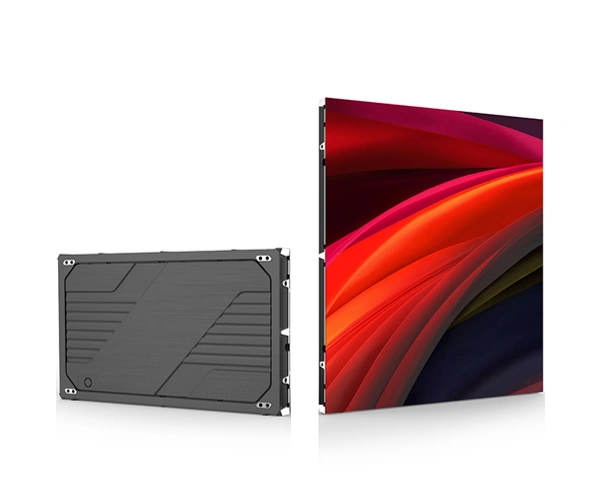
Once a manufacturer is selected, the next significant decision is LED packaging technology. This choice affects price by 20%–60% and image quality at close viewing distances.
SMD (Surface Mount Device)
The mature, mainstream LED packaging technology. Individual red-green-blue LED chips are packaged into small units and surface-mounted onto the PCB. SMD has powered most of the LED display industry over the past two decades.
Best applications: pixel pitch P2.5 and larger; outdoor installations; rental and touring (where field repair is needed); cost-sensitive projects.
Considerations: Below P1.25, manufacturing yield rates drop and visible grid lines become more apparent at close viewing distances. Individual lamp beads can be damaged if physically touched.
COB (Chip-on-Board)
An advanced packaging technology where LED chips are mounted directly onto the PCB and encapsulated together in resin as a unified module. This eliminates discrete LED packages and creates a smoother surface.
Best applications: pixel pitch P1.5 and smaller; close-viewing applications (control rooms, executive boardrooms); high-touch environments; broadcast and virtual production where image quality at close range is critical.
Considerations: Typically 10%–30% price premium over equivalent SMD. Module repairs require returning to the factory rather than field replacement. Excellent durability and uniformity benefits offset these trade-offs in premium applications.
GOB (Glue-on-Board)
A hybrid approach: standard SMD modules with a transparent protective resin coating applied across the entire surface. Combines SMD’s manufacturing maturity with improved physical durability.
Best applications: rental and touring SMD displays needing impact protection; educational and retail environments where screens may be touched; situations requiring fine-pitch (P2.5 and below) with field-repair capability.
Considerations: Approximately 15% price premium over standard SMD. Visual quality improvements are modest compared to true COB.
Quick Decision Reference
| Application Type | Recommended Technology |
|---|---|
| Outdoor billboards (P4 and larger) | SMD |
| Stadium and large-venue screens | SMD |
| Standard rental/staging (P3.91, P4.81) | SMD or GOB |
| Conference rooms (P2.5) | SMD or COB |
| Premium control rooms (P1.5 and below) | COB |
| Virtual production LED volumes | COB |
| Broadcast studio backdrops | COB |
| High-touch retail kiosks | GOB or COB |
Frequently Asked Questions
What’s the typical lifespan of a Chinese-manufactured LED video wall?
Quality indoor LED video walls typically have a useful lifespan of 80,000–100,000 hours at 50% brightness — roughly 9–11 years of typical operation. Outdoor screens, due to higher operating brightness and weather exposure, typically last 60,000–80,000 hours. Gradual brightness reduction and color shift typically begin after 5–7 years of intensive use.
What’s the minimum order quantity (MOQ)?
Most established Chinese LED factories accept orders starting from 4–6 m² for standard products. Below that, some factories apply small-order surcharges of 10%–25%. For OEM/ODM partnerships with custom branding, MOQ typically starts at 50–100 m² to make tooling and packaging customization economically viable.
What warranty terms are standard?
Two-year warranty is standard across the industry, with 3–5 year extensions available from most reputable manufacturers. Practical warranty service depends heavily on whether the factory has regional spare parts availability or a service partner in your country. For installations expected to operate 5+ years, a longer warranty with regional service support is worth the modest price difference.
How long does production typically take?
Standard configurations (P3.91 outdoor, P2.5 indoor) typically ship within 15–25 days from order confirmation. Custom configurations including curved cabinets, transparent screens, or ultra-fine pitch COB take 30–45 days. OEM orders with custom branding typically take 35–55 days including artwork approval cycles. Sea freight to North America/Europe adds 25–35 days; air freight adds 7–10 days at approximately 4× the cost.
Should I choose SMD or COB for outdoor applications?
For outdoor applications, SMD is generally the more practical choice in 2026. Outdoor pixel pitches typically range from P3 to P10 — well above the P1.5-and-below range where COB’s advantages become significant. SMD’s mature manufacturing process also enables easier and more cost-effective field repairs, which matters more for outdoor installations exposed to environmental stresses.
P2.5 vs P3.91 — how should I choose?
A useful rule of thumb: minimum comfortable viewing distance ≈ pixel pitch (mm) × 1 meter. P2.5 displays look pristine from approximately 2.5 m viewing distance, while P3.91 is comfortable from 4 m. For conference rooms with front-row viewing at 3–5 m, P2.5 is the typical choice. For stages and event backdrops where the closest audience is 6+ m away, P3.91 saves 35%–50% in cost with no perceptible quality difference at typical viewing distances.
Are Chinese-manufactured LED panels acceptable for the EU and US markets?
Yes, provided the factory holds genuine CE, FCC, and RoHS certifications with complete test reports from accredited laboratories. Most established Chinese LED manufacturers maintain these certifications as standard for export-oriented production. When evaluating suppliers, requesting the complete test reports (including lab name, model numbers tested, and test conditions) helps verify certification authenticity before shipment.
Is it possible to source remotely without visiting Shenzhen?
Most international B2B LED projects are sourced remotely. The key elements are: a clear specification document, video-based factory tours (which most manufacturers offer), itemized quotes for accurate comparison, references from similar past projects, and — for larger projects — third-party inspection services. SGS, Bureau Veritas, and TÜV Rheinland all offer factory audit services in the Shenzhen area for $400–$800. For projects above $200,000, an in-person visit before final supplier selection is still worthwhile when feasible.
The Smart Alternative: Why Mid-Sized Factories (Like Unishine LED) Win B2B Projects
While the Top 12 giants dominate the mega-project space, the vast majority of international B2B buyers—system integrators, regional rental houses, and DOOH operators—require a different kind of partner. This is exactly the gap Unishine LED fills.
Instead of competing on sheer volume with the corporate giants, Unishine focuses on being the ultimate manufacturer-direct partner for agile B2B buyers. We eliminate the “big brand markup” and offer:
- Manufacturer-Direct Pricing: Get premium components (like Nationstar LEDs and high-refresh ICs) without the 30% Tier-1 brand premium, directly lowering your project’s break-even point.
- Zero-Red-Tape Communication: You speak directly with our senior engineers and product managers, not a tiered customer service desk. Custom OEM/ODM requests are handled in days, not months.
- Agile Lead Times: Without the backlog of massive stadium orders, our production lines are optimized to deliver mid-volume projects (50–500 sqm) faster and with stricter batch-consistency control.
- Local Reliability: Access to UL-certified products and local spare parts inventory in the US and Europe, ensuring your project stays live without waiting for weeks on international shipping.
Ready to Discuss Your Project?
Whether you’re sourcing for a single installation, comparing quotes for a fixed-install project, planning an OEM partnership, or building a rental fleet — we’d be glad to provide a detailed quote and engineering input for your specific application.
Tell us a bit about your project (pixel pitch, dimensions, application, target market) and we’ll respond within 24 hours with itemized pricing, lead time, and any technical recommendations relevant to your specifications.
You can also explore our quality control process, product range, or company background for more information before reaching out.
Sourcing LED displays from China is a meaningful project that benefits from clear specifications, careful supplier evaluation, and transparent communication on both sides. We hope this guide is useful as you evaluate your options — whichever supplier you ultimately partner with.