Why Your Event Success Depends on the LED Screen
A flashing background, visible black line, or sudden screen blackout can ruin a high-value concert, product launch, trade show, or corporate event in seconds.
For event planners, AV integrators, and rental buyers, the biggest challenge is not simply finding an LED screen. The real pressure comes from making sure the visual system performs flawlessly at the exact moment the audience, cameras, sponsors, and clients are watching.
In 2026, every attendee with a smartphone can become a broadcaster. If the screen flickers on camera, shows dead pixels, displays visible seams, or fails during the climax of the show, the damage can spread across social media instantly.
That is why choosing a rental LED display is not just a hardware decision. It is a risk-control decision, a brand-protection decision, and a direct investment in event ROI.
This guide explains how to choose the right rental LED screen based on venue size, viewing distance, indoor or outdoor use, stage design, setup speed, logistics, and long-term service support.
Planning a Rental LED Display for a Live Event?
Share your stage size, viewing distance, event location, and setup deadline to get a rental LED recommendation before showtime.
Rental LED Display Checklist for Event Planners
Many event planners do not have a technical background, but they still need to make high-pressure LED screen decisions. Before comparing prices, start with the real event scenario.
1. Measure the Viewing Distance
The most important starting point is the distance between the screen and the audience.
If the front-row audience sits very close to the screen, you need a finer pixel pitch to keep text, faces, and graphics sharp. If the audience is far away, using an ultra-small pixel pitch may waste budget without creating visible value.
As a basic rule:
- P2.97 is suitable for indoor events, conferences, exhibitions, and close viewing.
- P3.91 is a cost-effective standard for outdoor stages, concerts, festivals, and large venues.
- Larger pitches such as P4.81, P5.95, or P10 may work for long-distance viewing, outdoor advertising, sports events, or large-scale background visuals.
Choosing the right pixel pitch prevents two common mistakes: overpaying for resolution the audience cannot see, or using a screen that looks pixelated from the front row.
2. Confirm the Installation Timeframe
Venue rental, rehearsal schedules, lighting setup, camera testing, and sound checks all depend on installation speed.
Before signing a rental contract, ask the supplier:
- How many hours are required for installation?
- How many technicians will be on site?
- Can the screen be assembled before rehearsal?
- Does the cabinet design support fast locking and quick alignment?
- Is the setup method stacking, hanging, curved splicing, or truss mounting?
Modern rental LED screens such as U-Rent, U-Rent-H, and U-Rent-J are designed for repeated installation, fast assembly, and easier handling in event environments. Compared with older heavy cabinets, this type of rental-focused structure can help reduce labor pressure and shorten setup time, especially for touring events and repeated installations.
3. Verify Power Requirements
LED screens require stable power supply. Outdoor screens, high-brightness displays, and large video walls may require high-voltage power distribution and professional cabling.
Ask the supplier to provide:
- Total power consumption
- Peak power consumption
- Voltage requirements
- Backup power recommendations
- Cable routing plan
- Power distribution box requirements
Clarifying power requirements early prevents circuit breaker trips, unstable brightness, and last-minute venue conflicts.
4. Ask About Spare Parts and On-Site Maintenance
Every live event needs backup components.
A professional rental LED supplier should prepare spare modules, power supplies, receiving cards, signal cables, and maintenance tools on site. If dead pixels, impact damage, or signal problems appear during setup or performance, technicians must be able to replace faulty parts quickly.
Front-maintenance designs are especially valuable for live events. Instead of dismantling the screen from the rear, technicians can service the display from the front, reducing repair time and avoiding backstage access problems.
5. Clarify Technical Support
Do not assume technical support is included in a standard rental quote.
Confirm whether the supplier provides:
- On-site engineers
- Full-event standby support
- Signal testing before rehearsal
- Video processor configuration
- Camera compatibility testing
- Emergency response during the event
For concerts, product launches, trade shows, and high-profile corporate events, on-site engineering support is not optional. It is part of the event insurance.
6. Check Logistics and Insurance
Rental LED screens move frequently between warehouses, venues, trucks, aircraft, and storage areas. Transport damage is a major hidden risk.
Before confirming the order, clarify:
- Who handles transportation?
- Are professional flight cases included?
- Is insurance included?
- Who is responsible for damage during transport?
- Are customs, duties, or local delivery fees included?
- How fast can replacement parts arrive?
A low rental price can become expensive if logistics, insurance, customs, or emergency replacements are not included.
P3.91 vs. P2.97: How to Choose the Right Pixel Pitch
Pixel pitch determines the distance between LED pixels. The smaller the number, the higher the pixel density and the sharper the image at close range. However, smaller does not always mean better.
P3.91: Outdoor and Large-Venue Rental Standard
P3.91 is widely used for outdoor concerts, festivals, sports events, large stages, and long-distance viewing scenarios.
It offers a strong balance between brightness, image clarity, cabinet cost, and installation efficiency. For audiences standing or sitting more than several meters away, P3.91 usually delivers excellent visual performance without unnecessary cost.
For outdoor and demanding rental environments, products such as U-Rugged, U-Shield, U-Max, U-Rent-H, and U-Rent-J can be positioned around durability, brightness, structural strength, and stable performance under repeated handling.
P2.97: Indoor High-Definition Choice
P2.97 is better suited for indoor conferences, corporate annual meetings, exhibition booths, product launches, and premium stage backdrops.
When viewers are close to the screen, finer pitch helps small text, product details, speaker close-ups, and brand visuals stay sharp. This is especially important for camera recording and live streaming.
For close-viewing indoor projects, U-Fit, U-Slim, U-Panel, U-RP, and U-Podium can be used to support different installation needs, including conference stages, retail environments, exhibition spaces, and premium presentation areas.
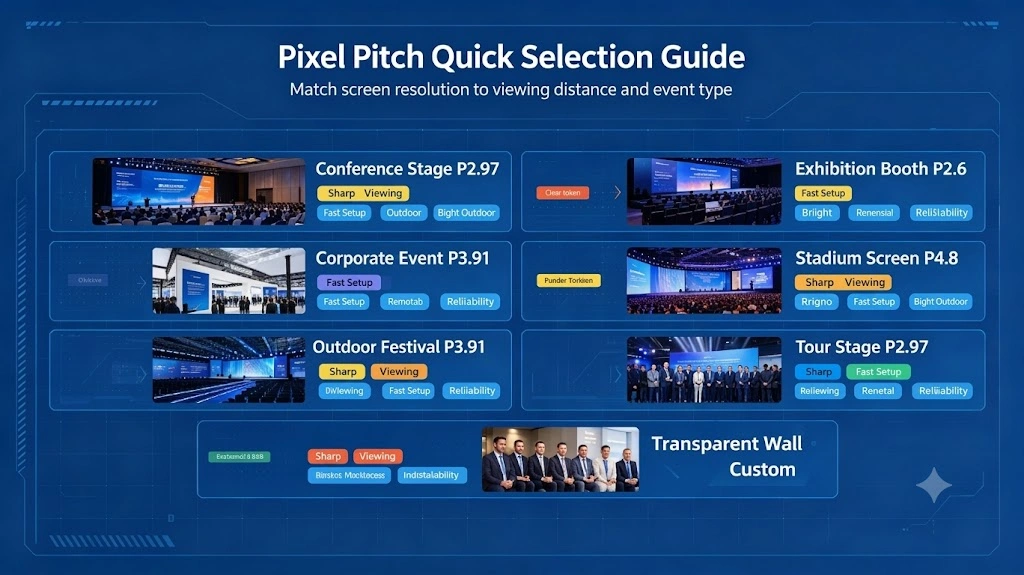
Quick Selection Guide
Match the Right Pixel Pitch to Your Event Scenario
Use this event-based guide to compare viewing distance, rental LED pitch range, and suitable Unishine product directions.
Not Sure Which Pixel Pitch Fits Your Event?
The right rental LED screen depends on viewing distance, screen size, venue type, camera setup, and installation method.
- P2.97 for close indoor viewing
- P3.91 for outdoor stages and large venues
- Higher refresh rate for camera recording
- Fast-lock cabinet for quick setup
Indoor vs. Outdoor Rental LED Displays: Key Differences You Must Know
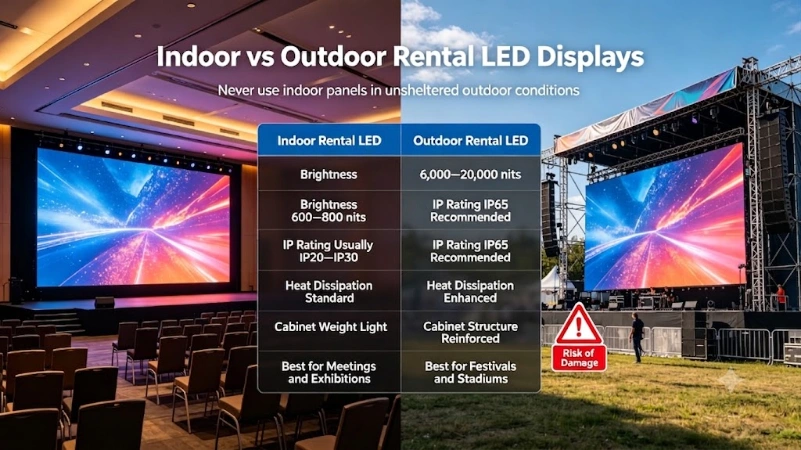
Using an indoor LED screen outdoors to save money is one of the most dangerous rental mistakes.
Indoor LED screens are not designed for direct sunlight, heavy rain, dust, wind, or temperature changes. Outdoor rental LED screens are built for visibility, weather resistance, and structural strength.
For outdoor events, choose panels with high brightness, IP65 protection, strong cabinet structure, and high refresh rate. Products such as U-Rugged, U-Shield, U-Max, U-R10, and U-Rent-H are more suitable for projects where weather resistance, structural safety, and long-distance visibility matter.
For indoor events, prioritize fine pixel pitch, high contrast, low-brightness high-gray performance, quiet operation, and slim installation design. Products such as U-Fit, U-Slim, U-Panel, U-RP, and U-Podium are better aligned with indoor stages, corporate venues, retail displays, and exhibition spaces.
High Refresh Rate: The Camera-Ready Standard for 2026 Events
In 2026, LED screen quality is not judged only by what the human eye sees. It is also judged by what smartphones, broadcast cameras, and livestream equipment capture.
Low-refresh-rate LED screens often create flickering lines, moiré patterns, or black scanning bands on camera. This can ruin live streams, audience-generated videos, and social media content.
Professional rental LED displays should support high refresh rates such as 3,840Hz or 7,680Hz, depending on the project requirements. High refresh performance helps ensure that photos, videos, and broadcast feeds look smooth, stable, and flicker-free.
For concerts, product launches, sports events, and televised shows, refresh rate should be treated as a core specification, not a secondary detail.
Stage Backdrop Design: Creative Ways to Use Rental LED Screens
Modern audiences expect more than a flat video wall. Rental LED screens now shape the entire stage environment and visual narrative.
1. Seamless Curved LED Walls
Curved LED splicing creates a more immersive visual field than traditional flat screens. Rental cabinets that support curved locking angles can wrap the stage and create a seamless panoramic background.
Products such as U-Rent, U-Stage, and U-MagicStage can be positioned for concerts, immersive exhibitions, fashion shows, and high-end brand launches where curved or creative stage layouts are required.
2. Staggered LED Layouts
Instead of building one flat rectangle, designers can suspend multiple LED blocks at different depths and heights.
This creates a layered 3D stage effect, making the visual structure feel more dynamic and architectural. U-Kinetic, U-Cube, U-Rotation, and U-Pole can be used for more creative visual structures, moving installations, and spatial display concepts.
3. Transparent LED Screens
Transparent LED screens are ideal for luxury retail events, glass-window stages, exhibitions, and futuristic product launches.
When powered off, they maintain a high-transparency appearance. When activated, they create floating visual effects that can blend with real products, performers, or physical stage elements.
For buyers planning this type of effect, transparent LED screen price should be evaluated together with transparency rate, brightness, pixel pitch, cabinet structure, installation method, and content design requirements.
Products such as U-Trans, U-TFP, and U-FP can be introduced for projects that require transparency, light transmission, and futuristic visual presentation.
4. Interactive LED Floor Displays
LED floor screens expand the stage from vertical backdrop to ground-level interaction.
Interactive LED floor displays can respond to performers’ movements, creating real-time visual effects beneath dancers, hosts, or product presenters. For stage safety, load-bearing capacity, anti-slip surface design, and impact resistance must be carefully checked.
U-Floor is suitable for interactive stage floors, dance performances, immersive exhibitions, and entertainment venues where ground-level visuals are part of the audience experience.
5. IMAG Screens for Large Events
For outdoor festivals, stadium concerts, and large conferences, Image Magnification screens are essential.
IMAG screens show close-ups of singers, speakers, athletes, or performers, allowing people far from the stage to experience facial expressions, hand movements, and emotional details.
For large venues, IMAG screens should be high brightness, high refresh rate, and carefully matched with camera systems. U-Max, U-Shield, U-R10, U-Rent-H, and U-Rent-J can support large-scale viewing environments where brightness, refresh rate, and structural reliability are critical.
2026 Rental LED Display Cost Analysis: What Really Affects the Price?
Rental LED display pricing is influenced by far more than screen size.
The final cost usually depends on pixel pitch, cabinet quantity, installation complexity, event duration, transport distance, technical support, video processors, cables, power distribution, insurance, and spare parts.
1. Pixel Pitch
Smaller pixel pitch usually means higher LED density, higher manufacturing cost, and higher rental price.
For example, P2.97 typically costs more than P3.91 because it contains more pixels per square meter and provides sharper close-viewing performance.
2. Screen Size
Larger screens require more cabinets, more rigging hardware, more power, more signal processing, and more installation labor.
However, a larger screen with a suitable pixel pitch may sometimes deliver better ROI than a smaller screen with an unnecessarily fine pitch.
3. Rental Duration
One-day rentals usually have the highest daily cost because transportation, setup, testing, and dismantling still require full labor input.
Multi-day events, exhibitions, tours, and roadshows often receive better package pricing.
4. Installation Complexity
Ground-stacked flat screens are usually easier and cheaper to install.
Suspended screens, curved screens, irregular layouts, transparent LED structures, LED floors, and multi-screen stage designs require more engineering, more safety checks, and more labor.
5. Technical Support
Some quotes only include hardware rental. Others include technicians, processors, signal testing, backup parts, and event standby support.
Always confirm what is included before comparing prices.
6. Hidden Costs
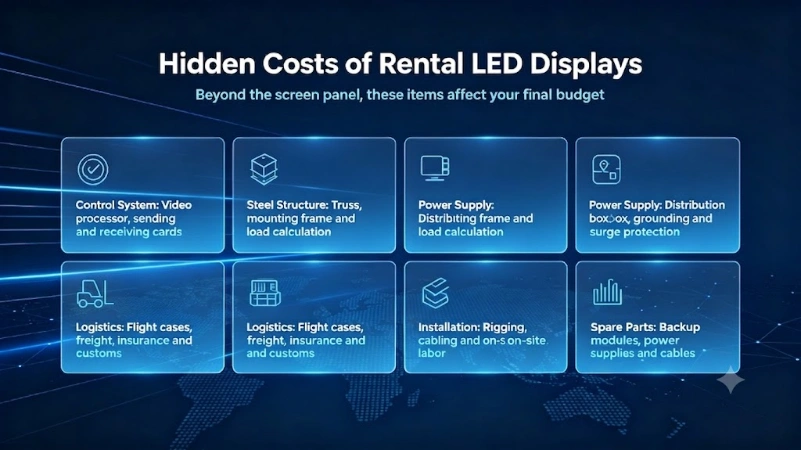
Many event budgets underestimate hidden costs. Before signing the contract, ask whether the quote includes:
- Professional installation labor
- Video processor rental
- Signal cables and fiber optic cables
- Power distribution equipment
- Truss or hanging structure
- Flight cases
- Logistics insurance
- Spare modules and backup receiving cards
- On-site engineer support
- Dismantling and return transport
Clarifying these details can prevent the final invoice from exceeding the original budget.
Avoid Last-Minute Rental LED Cost Surprises
Pixel pitch, screen size, setup method, processor rental, logistics, insurance, spare parts, and on-site support can all affect the final rental cost.
Buying vs. Renting: Which Model Fits Your Business?
Different buyers should evaluate rental LED displays from different business perspectives.
For AV Rental Companies and Wholesalers
If you operate an AV rental company, LED screens are long-term commercial assets.
Your focus should not be only the lowest purchase price. You should evaluate Total Cost of Ownership, including failure rate, cabinet durability, repair cost, spare parts availability, setup efficiency, and rental utilization rate.
A screen that is cheaper upfront but frequently fails will reduce rental income and increase maintenance pressure.
For rental businesses, reliable cabinets, fast locking, front maintenance, high refresh rate, and strong flight-case protection directly affect profitability. U-Rent, U-Rent-H, U-Rent-J, U-Stage, U-Shield, and U-Rugged can be positioned for rental companies that need repeated setup, transportation protection, and stable commercial utilization.
For Event Organizers and Corporate Brands
If your company only hosts several events per year, buying a full LED wall may not be practical.
You need storage space, transport capability, technical staff, spare parts, maintenance tools, and setup experience. In most cases, renting through professional AV partners is more efficient.
However, even when renting, you still need to evaluate the hardware quality behind the quote. A low-cost rental screen with poor refresh rate, weak protection, or high failure risk can damage the entire event.
Fast Delivery and Local Support for European Projects
Delivery speed can decide whether an event project succeeds or fails.
For European system integrators, rental companies, and event contractors, long ocean freight timelines and customs uncertainty can create serious scheduling risks.
A localized warehouse in the Netherlands helps shorten delivery time for European projects by avoiding the traditional four-to-six-week shipping cycle from Asia. Local stock allows urgent project orders, spare parts, and replacement cabinets to move faster within the European market.
For buyers working under tight event deadlines, the advantages include:
- Faster delivery within Europe
- Reduced customs complexity inside the EU
- Lower risk of unexpected tariff or clearance delays
- Easier spare parts replenishment
- Local-time-zone technical response
- Better support during rehearsal and setup
For urgent events, local inventory and fast technical response can be just as important as the LED screen specification itself.
Global Logistics Options for International LED Display Buyers
For buyers outside Europe, global logistics planning is still a key part of rental LED procurement.
Common delivery options include:
Air Freight
Air freight is suitable for urgent projects, replacement modules, small-batch orders, and time-sensitive event deadlines.
It is faster but more expensive than sea freight.
Sea Freight
Sea freight is usually the most economical choice for large-volume LED cabinet orders.
It is suitable for rental companies, wholesalers, and long-term inventory planning, but buyers need to allow enough time for production, packing, customs, and local delivery.
DDP Door-to-Door Delivery
DDP delivery can help buyers avoid complex customs paperwork and unexpected import charges.
For small-to-medium enterprises, churches, event companies, and first-time importers, DDP service can simplify the buying process by delivering goods directly to the warehouse or venue.
What Defines a Professional Rental LED Display Supplier?
A professional rental LED supplier should provide more than panels. It should provide a complete risk-control system.
1. Factory Quality Control
Rental LED screens face constant transport, installation, dismantling, and handling. Strong quality control is essential.
Important quality-control steps include:
- Full-screen aging test
- Dead-pixel inspection
- Brightness and color calibration
- Module consistency testing
- Vibration testing
- High and low temperature testing
- Waterproof testing for outdoor models
For demanding rental environments, these tests help reduce the risk of early component failure.
2. Strong Cabinet Design
Rental cabinets should be lightweight, durable, easy to align, and fast to assemble.
Key design points include:
- Die-casting aluminum cabinet
- 500x500mm or 500x1000mm modular size
- Fast-lock system
- Precise splicing
- Curved installation compatibility
- Front maintenance
- Strong corner protection
- Flight-case compatibility
3. On-Site Maintenance Efficiency
Live events require fast problem solving.
Front-maintenance structures allow technicians to service individual modules from the front using professional tools. This reduces repair time and makes maintenance easier in venues where rear access is limited.
4. Spare Parts and Technical Support
A reliable supplier should provide spare modules, power supplies, receiving cards, cables, and technical guidance.
For international buyers, remote support, installation guidance, wiring diagrams, and fast spare-part delivery are especially important.
5. Certifications and Long-Term Warranty
For professional B2B buyers, certifications and warranty policies help reduce procurement risk.
Relevant certifications may include CE, FCC, RoHS, and ISO-related quality systems, depending on the target market.
Unishine Rental LED Display Solutions
Unishine provides LED display solutions for rental companies, system integrators, event contractors, stage designers, commercial brands, and global distributors.
With years of manufacturing experience, automated production capability, strict quality control, and international service support, Unishine focuses on helping clients reduce event risk and improve long-term display ROI.
Stage Rental LED Displays
For concerts, touring shows, corporate events, festivals, and live performances, U-Rent, U-Rent-H, U-Rent-J, U-Stage, and U-MagicStage can be used to support fast setup, repeated handling, curved stage structures, and high-impact live visuals.
Key advantages include:
- Fast assembly
- Strong cabinet structure
- High refresh rate
- Front maintenance
- Curved splicing options
- Reliable performance for repeated rental use
Outdoor High-Brightness LED Displays
For outdoor concerts, sports venues, mobile event trucks, outdoor campaigns, and harsh weather environments, U-Rugged, U-Shield, U-Max, U-R10, and U-MAX-B can be positioned around brightness, stability, weather resistance, and structural safety.
Key advantages include:
- High brightness
- Outdoor protection options
- Strong weather resistance
- Stable outdoor performance
- High refresh rate
- Durable cabinet design
Indoor HD Event and Conference Displays
For indoor conferences, exhibition booths, brand launches, control rooms, retail displays, and premium presentation spaces, U-Fit, U-Slim, U-Panel, U-RP, U-Podium, and U-Poster can support close-viewing clarity and refined visual performance.
Key advantages include:
- Fine pixel pitch
- High contrast
- Close-viewing clarity
- Slim structure
- Quiet operation
- Front maintenance design
Transparent and Creative Display Solutions
For retail windows, exhibitions, luxury brand events, automotive launches, and futuristic stage designs, U-Trans, U-TFP, U-FP, U-Art, U-Booth, and U-Box can help create more flexible visual presentation formats.
Key advantages include:
- High-transparency display options
- Lightweight structure
- Creative installation formats
- Reduced blocking of natural light
- Strong visual impact for commercial spaces
Interactive and Special-Shape Display Solutions
For immersive stages, digital art spaces, commercial activations, and entertainment venues, U-Floor, U-Kinetic, U-Cube, U-Rotation, U-Pole, U-MagicSky, and U-Sky can support more dynamic stage and spatial display ideas.
Key advantages include:
- Interactive stage effects
- Floor display applications
- Moving or kinetic visual structures
- Special-shape display possibilities
- Strong audience engagement
Transportation and Mobile Display Solutions
For mobile advertising, commercial vehicles, public transport, and outdoor mobility scenarios, U-Bus, U-Taxi-D, U-Taxi-A, U-Taxi-B, U-Taxi-Rear, and U-Trans can support flexible display deployment outside traditional venues.
Key advantages include:
- Mobile display applications
- Vehicle-mounted visual communication
- Outdoor visibility
- Flexible commercial advertising use
- Strong brand exposure in traffic environments
Recommended Cluster Topics for Deeper Reading
To help buyers make a more accurate decision, the following related topics can be explored in dedicated guides:
- LED Screen Rental Cost Guide
- Indoor vs. Outdoor Rental LED Display
- P3.91 vs. P2.97 Rental LED Screen
- How to Choose LED Screen Pixel Pitch
- Rental LED Cabinet 500x500mm Guide
- LED Display Refresh Rate for Camera and Live Streaming
- Stage LED Backdrop Design Ideas
- Transparent LED Screen Price Guide
- Fast LED Screen Delivery in Europe
- Buying vs. Renting LED Displays
- Front Maintenance LED Display Guide
- Outdoor IP65 LED Display Guide
Frequently Asked Questions
Does the rental price include technical support?
Not always. Many standard quotes only include hardware rental. You should confirm whether the price includes on-site engineers, signal testing, video processor setup, spare parts, emergency maintenance, installation, and dismantling.
How do I choose between P3.91 and P2.97?
Choose based on viewing distance and venue type. P2.97 is better for indoor events and close viewing, while P3.91 is a cost-effective choice for outdoor stages, festivals, and larger venues.
Can I use indoor LED screens outdoors?
No. Indoor LED screens are not designed for rain, dust, direct sunlight, wind, or temperature changes. Outdoor events should use high-brightness LED screens with IP65 or higher protection.
What refresh rate do I need for camera recording?
For professional events, live streaming, and smartphone recording, high refresh rate is essential. A refresh rate of 3,840Hz or higher helps reduce flicker, scanning lines, and camera artifacts.
Can a standard rental LED screen play 4K video?
It depends on the screen’s physical size and pixel pitch. The total resolution is calculated by the number of pixels across the full LED wall. You need to match the screen resolution with the video source and processor configuration.
Why are some rental LED screens much cheaper?
Low-cost screens may use lower-grade LEDs, weaker power supplies, less precise cabinets, limited testing, and poor spare-part support. The lower upfront price can lead to higher failure risk, more maintenance, and greater event uncertainty.
How fast can LED screens be delivered in Europe?
If products are available from a local European warehouse, delivery can be much faster than standard ocean freight from Asia. For urgent projects, local stock and local-time-zone technical response can significantly reduce schedule risk.
Build a Safer, Faster, and More Profitable Event Visual System
A rental LED display is not just a screen. It is the visual center of your event, the background of your brand story, and the technical foundation of your live presentation.
The right LED display helps you reduce setup pressure, protect event schedules, avoid on-camera flicker, prevent weather-related failures, and deliver a stronger audience experience.
Whether you are planning a concert, trade show, corporate launch, sports event, touring stage, or rental inventory upgrade, Unishine can help you choose the right rental LED display solution based on viewing distance, venue type, installation method, logistics timeline, and budget.
Submit your stage dimensions, event location, viewing distance, and installation deadline today.