Foldable LED Screen Guide: Choosing a Portable Advertising Display
Traditional LED poster displays sit in one place. A foldable led screen moves between locations, stores at half the volume, sets up in minutes, and manages content across multiple units from a single cloud dashboard. This guide covers the five features that determine whether a folding LED display actually works for multi-location advertising, retail campaigns, and exhibition use. Each section explains what the spec means when you are deploying displays across ten stores or fifty event booths rather than just one.
1. What a Foldable LED Screen Does That a Fixed Poster Cannot
A standard LED poster display is a rigid screen in a fixed frame. It requires a permanent floor position and a dedicated power source. Moving it means disassembling the frame, repacking the panel, and reassembling at the new location.
A folding led display folds along a central hinge to reduce its physical volume by approximately 50 percent. Folded, it becomes a compact unit that fits through standard doorways and into a vehicle without a dedicated transport case. Unfolded, it stands as a full-height advertising display. The folding mechanism replaces the fixed frame entirely. The display is the frame.
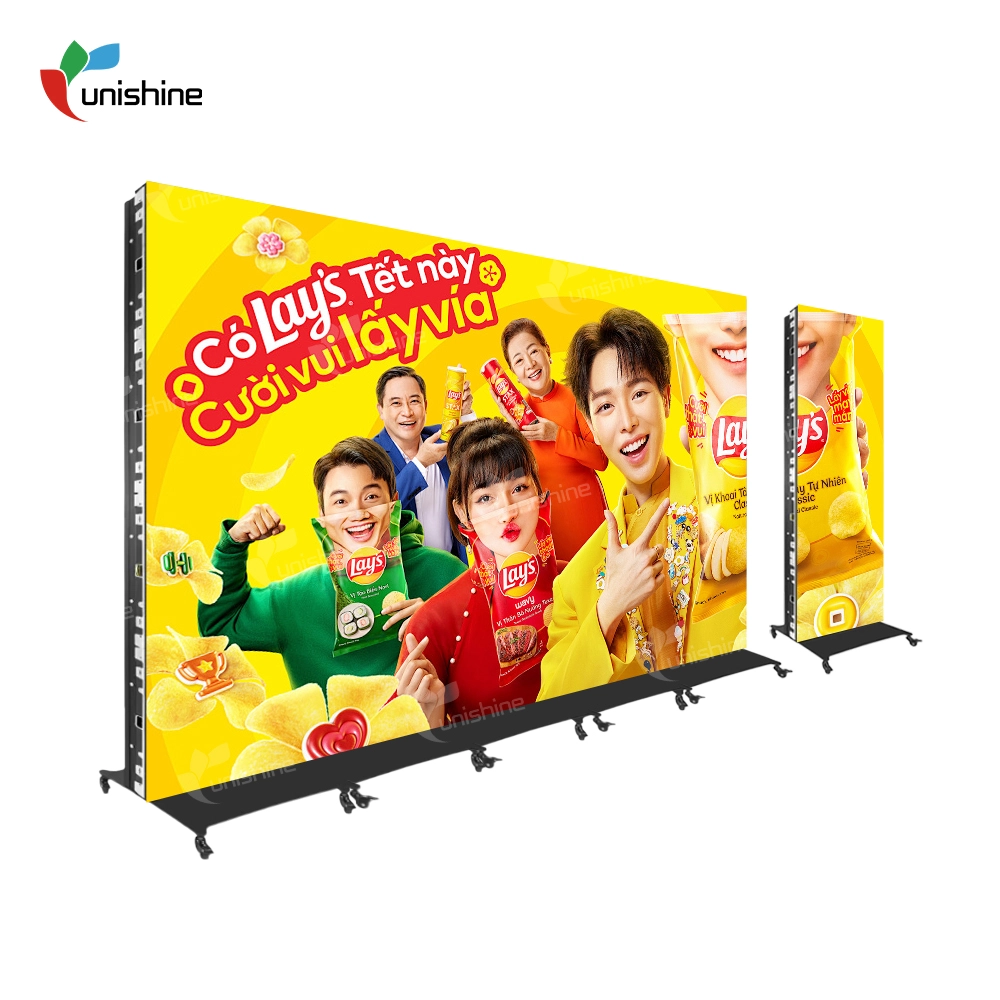
When folded, the screen transforms into a double-sided display capable of showing the same content on both sides or different content on each side. A unit positioned in a shopping mall corridor can show one promotion to approaching foot traffic on the front face and a different promotion to exiting traffic on the rear face. This doubles the advertising utility without adding floor space.
For multi-location campaigns, six individual units can be spliced into a seamless wider display wall. Magnetic detachable borders and a fast-lock alignment system connect six units in approximately five minutes.. A brand launching a product across ten retail stores can deploy a consistent six-panel video wall in each store without hiring installers at each location. The same six units that form a wall for the launch campaign can be separated and deployed as standalone foldable led poster displays in individual store windows the following month.
2. Fold-and-Go: Setup Without Tools or Technicians
A key distinction between a foldable LED advertising display and a standard LED wall is who can deploy it. A standard LED wall requires a technician who understands cabinet locking mechanisms, signal distribution, and processor configuration. A foldable display is designed so that store staff or event crew can handle the setup without a dedicated AV technician. The process does not require specialized installation knowledge, but a brief walkthrough of the folding mechanism and power connection before first use is recommended.
The folding frame is a structural component of the display itself. Unfold the unit. Lock the frame into position. Connect power. The display powers on and is ready to play content. No tools are involved. No separate mounting frame needs to be assembled. No processor needs to be configured. The system is self-contained.
When multiple units are spliced, the process uses magnetic detachable borders and a fast-lock alignment system. Borders snap on magnetically and are removed with the same motion. Adjacent units align through the locking mechanism built into the cabinet edges. Six units become a single seamless display surface in approximately five minutes. Disassembly reverses the process in the same time.
This speed matters for campaigns where the same equipment moves between venues on a schedule. A set of U-FP units deployed at a trade show on Monday can be packed, transported, and redeployed at a retail launch event on Wednesday by the same crew with no technical support call.
3. GOB Protection for High-Traffic Commercial Environments
Retail stores, exhibition booths, and shopping mall corridors are high-contact environments. Customers brush past displays. Children touch the screen surface. Cleaning staff wipe down equipment between shifts. A standard LED module with exposed SMD diodes will accumulate dead pixels from physical contact within months.
GOB (Glue-On-Board) protection applies a transparent protective layer over the entire LED module surface. The optical clarity is identical to an unprotected module. The physical durability is substantially better. The surface resists scratches, absorbs light impact, and can be wiped clean with standard cleaning products without risk of dislodging LED chips.
For a portable led advertising display that moves between venues and is handled by store staff rather than AV technicians, GOB protection is not optional. The same unit that is folded, loaded into a vehicle, unfolded at the destination, and positioned in a customer-facing area will survive this cycle repeatably with GOB. Without GOB, the unit will show visible pixel damage within a season of regular use.
The U-FP uses GOB module protection as standard. This means the protective layer is part of the manufacturing process rather than an aftermarket add-on. The module, the GOB layer, and the encapsulation are one integrated assembly.
4. Cloud Cluster Management for Multi-Location Campaigns
A single display in a single store is managed locally. Ten displays across ten stores create a content management problem. Updating each unit individually requires visiting each location or coordinating with each store manager to perform the update.
Cloud cluster management allows all units to receive content from a single publishing platform. Upload the new creative once. Transmit it to every unit on the network simultaneously. For campaigns with over one thousand units deployed across a region, one-click transmission replaces one thousand individual manual updates.
The platform also supports per-unit content differentiation. A nationwide retail promotion can display the same hero creative on all units while showing location-specific pricing, local store hours, or regional offers on individual units. The management interface treats the fleet as one network with per-unit override capability.
For advertising agencies managing campaigns on behalf of multiple brands, the cluster management approach separates the content operations workload from the hardware being in the right location. The hardware gets deployed once. The content changes remotely. This is the operational model that makes large-scale foldable digital signage deployments economically viable.
5. Pixel Pitch and Brightness for Close-Range Advertising
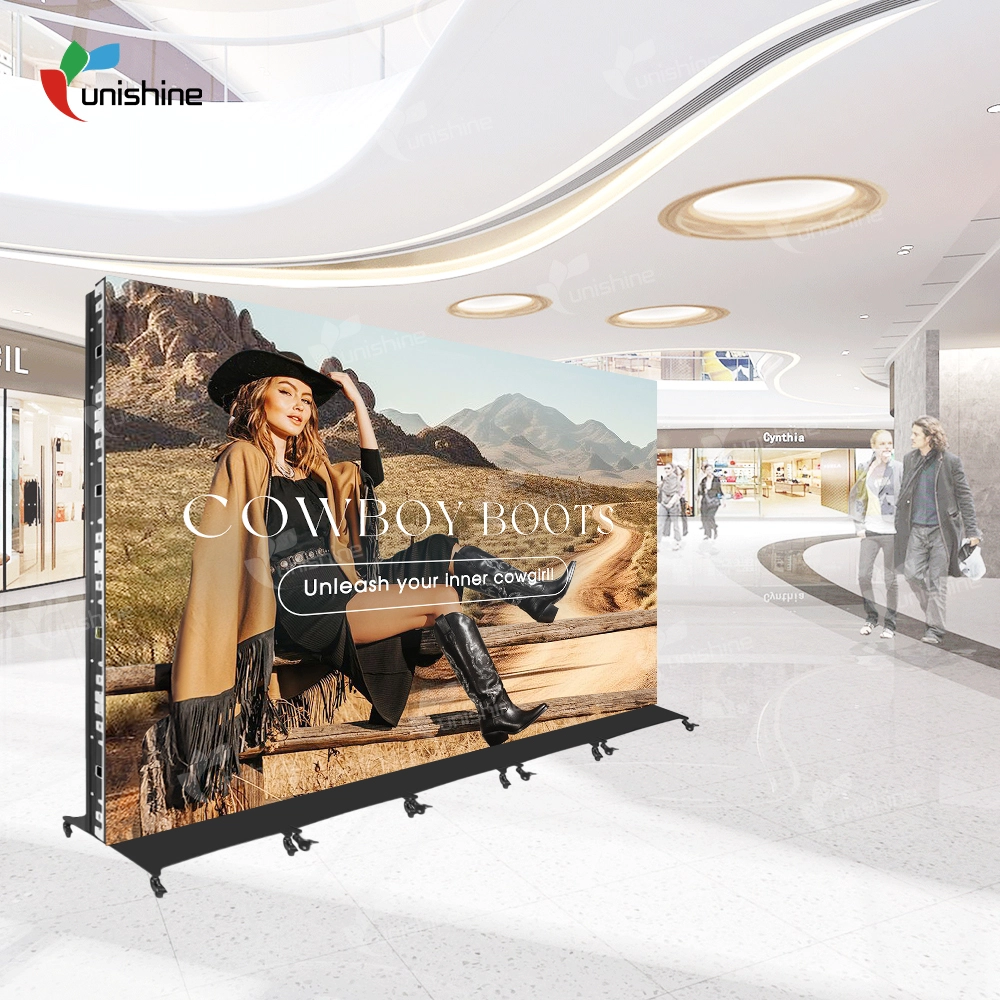
Foldable LED poster displays are viewed from close range. A unit positioned in a retail store window is 1 to 3 meters from the customer. A unit in a trade show booth is at arm’s length from the attendee. The pixel pitch must be fine enough that individual pixels are invisible at these distances.
P2.5 is the standard pitch for this product category. At 2 meters, a P2.5 display shows smooth text and clean product images. At 1 meter, individual pixels become visible to someone looking closely, but motion content and product photography still read as sharp. Finer pixel pitches than P2.5 are available. A finer pitch produces sharper text and more detailed product images at very close range, which matters for displays positioned within arm’s reach, such as a unit placed directly beside a product display table in a retail showroom. Choosing a finer pitch also increases the LED chip count per square meter, which adds cost. The decision depends on whether your displays will be viewed from 1 meter or closer, or from the more typical 2 to 3 meter distance in retail aisles and exhibition booths.
Brightness at 600 nits is sufficient for indoor retail and exhibition environments. Store lighting and exhibition hall illumination are bright but not outdoor sunlight. A poster display at 600 nits remains clearly visible against ambient indoor light without overpowering the retail environment. Higher brightness would be necessary for window displays facing direct morning or afternoon sun. For standard in-store and exhibition placement, 600 nits is the calibrated level for the viewing environment.
6. Where Foldable LED Screens Perform Best
Retail In-Store Promotions
A clothing store runs a seasonal sale. Two units at the entrance show the promotion. One unit near the fitting rooms shows styling suggestions. The units fold and store in the back room between campaigns. The same hardware serves winter sale, spring collection launch, and back-to-school promotions without permanent installation in any one location.
Trade Show and Exhibition Booths
An exhibitor attends six trade shows per year across three cities. Six units packed in a single rolling case deploy as a seamless video wall in the booth. The same six units separate into standalone poster displays for smaller regional shows. The foldable design and five-minute splicing mean the booth build does not need an AV technician on the crew.
Shopping Mall Common Areas
A mall operator places foldable displays in corridor intersections to promote tenant offers and upcoming events. Units move between corridors as the campaign rotates. The cloud platform pushes new content to all units weekly. No permanent installation. No wall mounting. No electrical work beyond plugging into the nearest outlet.
Hotel Lobby and Event Spaces
Directional signage for a conference on Monday. Welcome branding for a corporate event on Tuesday. Promotional display for a weekend brunch on Saturday. The same foldable unit stays in the lobby and changes content and physical position per event. Setup takes one person and a power outlet.
7. Conclusion
A foldable led screen replaces three things: the fixed LED poster frame with a self-supporting folding structure, the installation technician with a plug-and-play deployment process, and the per-unit content update with cloud cluster management. When evaluating products, confirm three non-negotiable specs. GOB protection must be standard, not an upgrade option, for any display handled by non-technical staff. The pixel pitch must match your closest viewing distance. The content management platform must support cluster control if you deploy more than three units across more than one location.
FAQ
Q1:Can a foldable LED screen be used outdoors?
The U-FP is rated IP40, which is designed for indoor environments. Outdoor use would expose the electronics to moisture and dust that the IP40 rating does not protect against. For a storefront window that receives direct sunlight, the 600 nits brightness may not be sufficient to compete with the sun. For covered outdoor areas such as a shaded event tent or a semi-enclosed mall walkway with no direct rain exposure, the display can operate, but it should not be exposed to precipitation or high humidity.
Q2:How durable is the folding mechanism with repeated use?
The folding hinge is integrated into the die-cast aluminum frame. The hinge is a structural component, not an add-on. With normal operation, the folding and unfolding cycle is designed to handle regular transport between venues. There is no published cycle count specification, so if your campaign involves daily folding and unfolding across many months, ask the manufacturer for the expected hinge lifespan under your specific usage pattern.
Q3:What happens to the power and data cables when the screen is folded and transported?
The power and data connections are designed to disconnect cleanly when the unit is folded. Cables are routed internally through the hinge path. When the unit is folded for transport, the cables retract with the frame. When unfolded, the connections are re-established as part of the frame locking process. No external cables need to be disconnected and reconnected during the fold-and-unfold cycle.
Q4:Can I run my own content, or do I need to use specific software?
The U-FP supports content in standard video and image formats. Content can be loaded via the cloud platform, a mobile app, or direct input. You are not locked into a proprietary content format. The cloud management platform handles scheduling and multi-unit distribution. If your team already produces content in standard formats, no format conversion is required before uploading.
Q5:What is the minimum number of units needed for a deployment?
A single unit works as a standalone advertising poster display. You do not need multiple units to use the product. Two to five units can be positioned independently at different locations within the same venue. Six units can be spliced into a single seamless video wall. The product scales from one unit to multiple units without requiring a minimum order or a different product model.