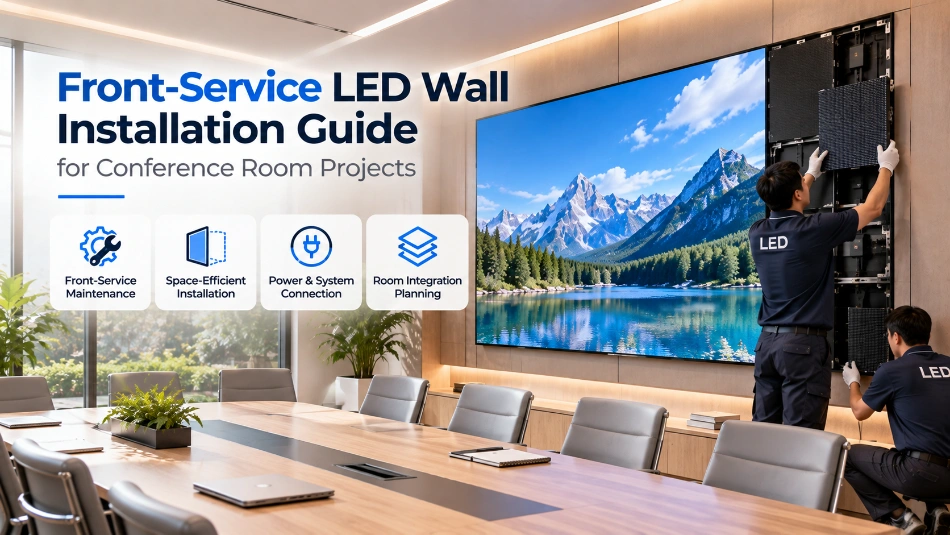
Installing an LED wall in a conference room requires more than selecting the right display product.
A successful installation depends on how the LED wall fits into the room environment, how maintenance will be managed, and how the display integrates with the overall meeting space.
For many corporate environments, space efficiency is an important consideration. Unlike large venues where access behind the display may be available, conference rooms often have limited installation space and fixed architectural layouts.
This is why front-service LED wall solutions are often considered for professional indoor applications.
A front-service design allows maintenance access from the front of the display, which can simplify installation planning in environments where rear access is restricted.
However, choosing a front-service LED wall is only one part of the project. Businesses should also evaluate wall conditions, installation requirements, system integration, and long-term operation before starting the installation process.
This guide explains the key considerations when planning a front-service LED wall installation for conference room projects.
What Is a Front-Service LED Wall?
A front-service LED wall is designed so that key maintenance access can be performed from the front side of the display.
This design approach can be useful in environments where the rear area of the LED wall is difficult to access or where the display needs to be installed close to a wall surface.
For conference rooms, this can provide advantages during project planning because the installation does not always require additional rear maintenance space.
However, front-service capability should be considered as part of the overall project design rather than as an independent feature.
The final installation approach should match:
- Room layout
- Wall structure
- Maintenance requirements
- Long-term operating conditions
A properly planned installation helps ensure that the LED wall remains accessible and practical throughout its service life.
Why Front-Service Design Matters for Conference Room LED Walls
Conference rooms often have different installation conditions compared with larger commercial or event environments.
Many boardrooms and corporate meeting spaces are designed with:
- Limited wall depth
- Fixed architectural structures
- Integrated furniture layouts
- Professional interior design requirements
In these environments, installation flexibility becomes important.
A front-service LED wall can help address situations where:
- The display is mounted close to the wall
- Rear access is difficult
- The room layout does not allow additional maintenance space
For corporate projects, the goal is not only to install a display but also to ensure the display can be operated and maintained efficiently over time.
Key Planning Considerations Before Installation
Evaluate the Installation Location
Before installing a front-service LED wall, the first step is understanding the installation environment.
The project team should evaluate:
- Wall condition
- Available installation space
- Display position
- Viewing area
- Surrounding equipment
A conference room LED wall should be positioned based on how participants use the room, not only where physical space is available.
The display location should support comfortable viewing while maintaining a professional room design.
Consider Wall Structure and Installation Conditions
The wall structure plays an important role in LED wall installation.
Different buildings and interior environments may have different requirements depending on:
- Existing wall construction
- Mounting conditions
- Installation method
- Project design
Proper evaluation before installation helps reduce unexpected adjustments during the project.
For professional projects, installation planning should be completed together with technical evaluation to ensure the display system matches the environment.
Plan Power and System Connections
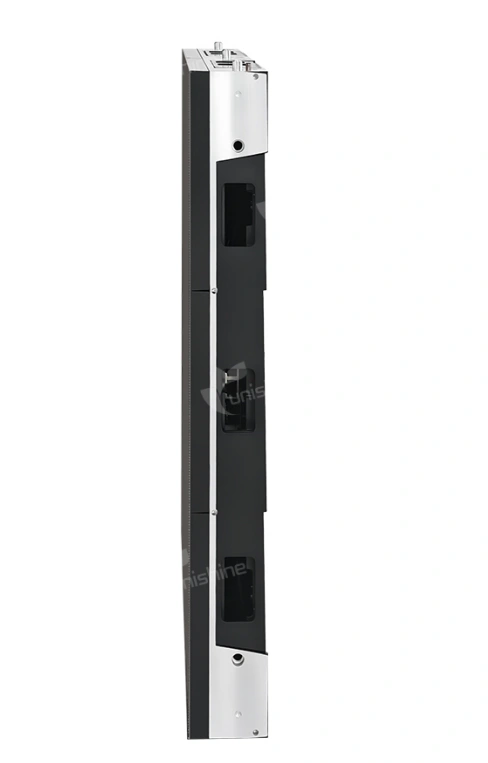
An LED wall installation requires coordination beyond the display itself.
Before installation, project teams should consider:
- Power requirements
- Signal connections
- Control system placement
- Integration with meeting room equipment
A conference room LED wall often works together with other technologies, including presentation systems and video conferencing solutions.
Planning these connections early helps create a cleaner and more reliable installation.
Maintenance Accessibility Planning for Front-Service LED Walls
Although front-service LED walls can simplify maintenance access in space-limited environments, maintenance planning should still be considered during the initial project design.
A professional LED wall installation should allow service teams to perform necessary inspections and maintenance efficiently without significantly affecting the surrounding environment.
For conference room projects, this is particularly important because meeting spaces often operate according to fixed schedules. Unexpected downtime can affect business activities and daily operations.
During planning, businesses should consider how the LED wall will be managed after installation, including:
- Access requirements
- Service procedures
- Long-term operation conditions
The goal is to create an installation that supports both immediate use and future maintenance needs.
A well-planned front-service installation helps businesses maintain a professional meeting environment while keeping future service considerations in mind.
Front-Service LED Wall Installation Workflow
A successful installation usually begins before the LED wall arrives on site.
The first stage is project evaluation.
During this stage, the installation team reviews the room environment, display location, and technical requirements to determine the appropriate installation approach.
The next stage involves preparing the installation conditions.
This may include confirming:
- Mounting requirements
- Power arrangements
- Signal connections
- Equipment positioning
After the environment is prepared, the LED wall can be installed and configured according to the project design.
The final stage involves testing and adjustment to ensure that the display works correctly within the conference room environment.
For professional projects, installation is not only about placing the LED wall on the wall. It involves coordinating the display with the room design, meeting workflow, and supporting technologies.
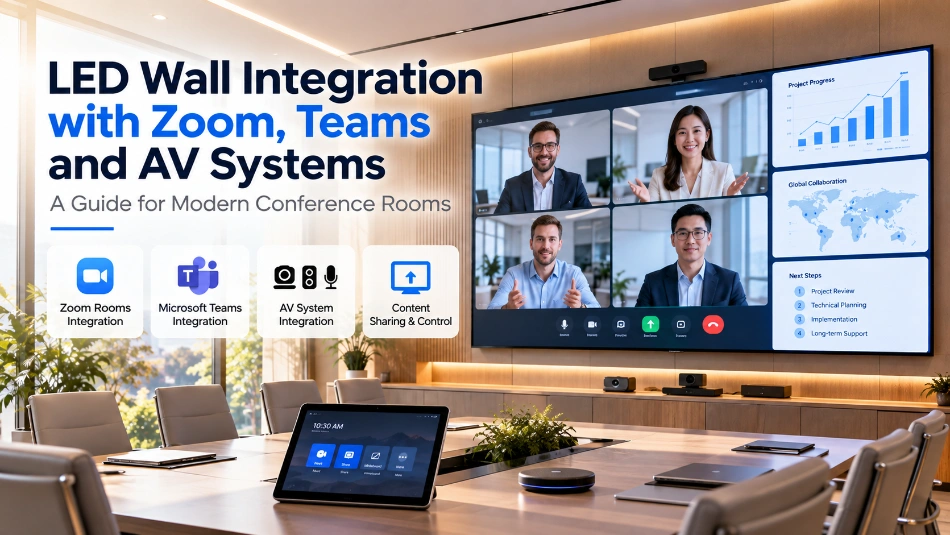
Integrating a Front-Service LED Wall with Conference Room Systems
Modern conference rooms often include multiple technologies working together.
An LED wall may need to integrate with:
- Video conferencing platforms
- Presentation systems
- Content sharing solutions
- Room control systems
Therefore, installation planning should consider how the LED wall interacts with the complete meeting environment.
For example, camera positioning should be considered together with display placement. A poorly planned layout may affect communication quality during hybrid meetings.
Similarly, content sources and control systems should be arranged in a way that allows users to operate the room efficiently.
A professional conference room LED wall is not simply a display device. It is part of a larger communication system.
Common Mistakes During Front-Service LED Wall Installation
Installing Without Considering Future Maintenance
One common mistake is focusing only on the initial installation and ignoring future service requirements.
Even with front-service capability, the project should still consider how technicians will access and manage the system over time.
Planning maintenance requirements early helps reduce potential operational challenges.
Ignoring Room Integration
Another mistake is treating the LED wall as an independent product.
Conference rooms usually contain multiple systems, and the LED wall should work together with other technologies.
A successful project considers the entire room environment rather than only the display installation.
Failing to Evaluate the Installation Environment
Every installation location has different conditions.
Factors such as wall structure, available space, and existing equipment can affect the installation approach.
A proper site evaluation helps avoid unexpected changes during implementation.
Why Work with an Experienced LED Display Manufacturer?
For conference room LED wall projects, manufacturing capability and project experience can play an important role in achieving a successful installation.
An experienced LED display manufacturer can help businesses evaluate application requirements, recommend suitable solutions, and provide technical support throughout the project process.
Unishine LED provides customized LED display solutions for global B2B customers, including manufacturing, OEM/ODM customization, project solutions, and international supply capabilities.
For professional indoor applications, Unishine LED provides LED display solutions including indoor LED displays, fine pixel pitch LED displays, and LED video wall solutions for conference rooms and corporate display environments.
For projects requiring specific installation conditions, customization capability can help businesses develop solutions based on actual application requirements.
Unishine LED supports product customization, specification customization, and project-based LED display solutions for different customer needs.
Conference Room LED Display Solution
FAQ About Front-Service LED Wall Installation
What is a front-service LED wall?
A front-service LED wall is designed to allow maintenance access from the front side of the display, which can be useful when rear access is limited.
Why are front-service LED walls suitable for conference rooms?
They can provide more installation flexibility in environments where meeting rooms have limited space behind the display.
What should be considered before installing a front-service LED wall?
Businesses should evaluate installation location, wall conditions, power requirements, system integration, and future maintenance needs.
Can a front-service LED wall support video conferencing environments?
Yes. With proper planning, the LED wall can be integrated with cameras, collaboration systems, and other conference room technologies.
Planning a Reliable Front-Service LED Wall Installation
A successful front-service LED wall installation requires more than selecting a display with maintenance access.
Businesses should consider the entire project environment, including installation conditions, room layout, system integration, and long-term operation.
By planning these factors in advance and working with an experienced LED display manufacturer, organizations can create a conference room display solution that supports reliable communication and professional meeting experiences.